
How to Turn a Short Story into a Short Film Script
Adapt a short story into a filmable short script with a focused beat map, visual action, and an earned ending. Includes a worked example and revision prompts.

To turn a short story into a short film script, identify the choice that changes the story, keep the events that make that choice understandable, and rewrite them as actions and dialogue an audience can follow. Then check whether the ending still means what it meant on the page.
A finished short story gives you material to work with. It also gives you decisions to make: which memories matter now, which locations you need, and what the audience must discover before the final scene. In their discussion of writing short films, John August and Craig Mazin emphasize the value of a focused central dilemma and clear visual storytelling.
This guide uses an original example to show those decisions. You can then upload your story to NovelToScreenplay, inspect an opening preview, and decide whether to develop the complete first draft. Start with material you own or have permission to adapt and upload.
Free opening preview. Sign in to export; full adaptation requires a paid pack.
Find the decision that holds the story together
Write one sentence describing what the protagonist wants, what stands in the way, and what they finally choose. If that sentence needs five subplots to make sense, reduce the scope before drafting.
Here is our fictional story, The Last Repair:
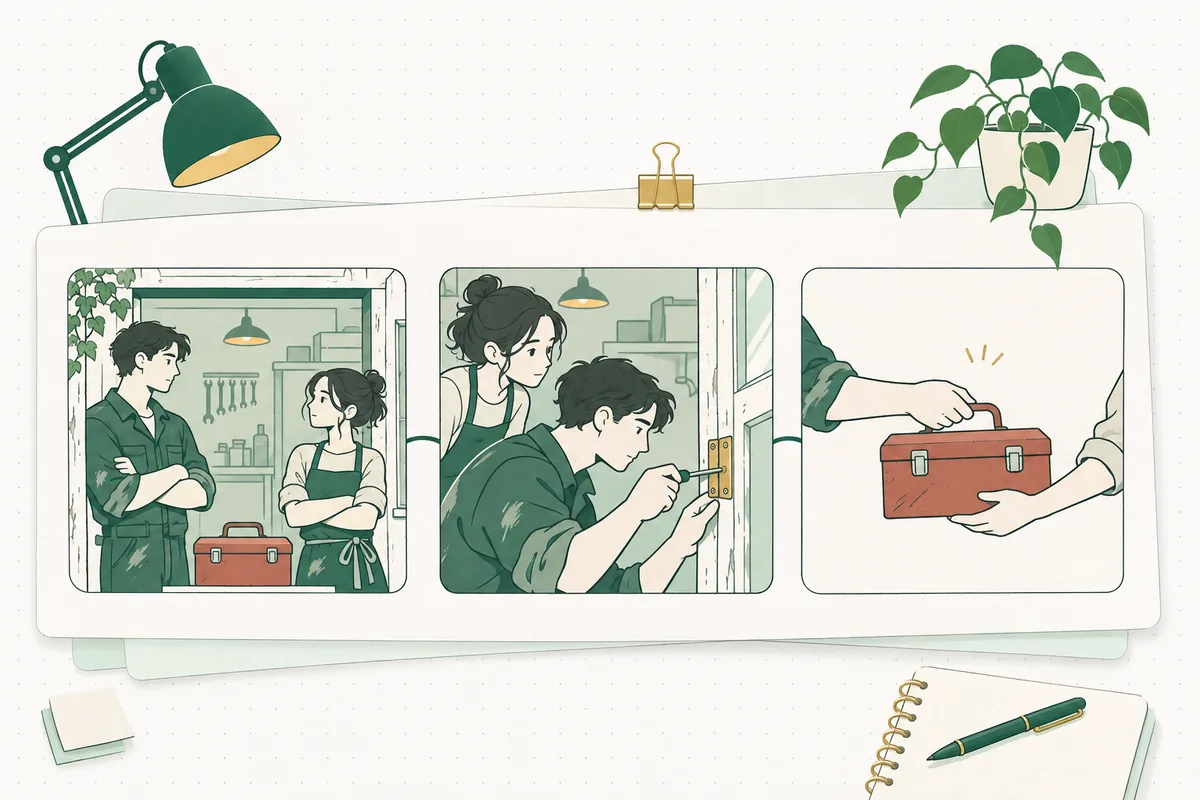
June is closing her late father's repair shop when her estranged brother Owen asks for his red toolbox. She assumes he will sell it. An apprenticeship offer reveals why he needs the tools, and his careful repair of the shop's loose door hinge changes her mind. June lends him the toolbox, choosing trust without pretending their history is resolved.
The film's central question is whether June will trust Owen with something that matters to her. His job offer supplies information. His behavior gives June a reason to act on it. Handing over the toolbox completes the change.
Protect that chain. If the adaptation makes June forgive him immediately, the ending becomes unearned. If Owen simply takes the box, June loses the decision that defines her story.
Decide what must remain and what can change
Separate the story's essential causes from the prose used to explain them. This gives you a concrete standard for reviewing a draft.
| Source material | Adaptation decision | Reason |
|---|---|---|
| June believes Owen sells valuable things when he needs money | Keep the suspicion | Her initial refusal needs a reason |
| A long memory of an earlier argument | Reduce to one specific reference if needed | The audience needs the wound, not its entire history |
| Owen carries an apprenticeship offer | Keep, but delay its readable reveal | It changes June's understanding of the request |
| June watches Owen repair the loose hinge | Keep | His behavior earns the change in trust |
| Descriptions of the bus ride to the shop | Cut | They do not alter the central decision |
| June lends him the red toolbox | Keep the action and its limited promise | The ending offers a chance, not complete reconciliation |
“Preserve the ending” means preserving the setup that makes it work. Keep track of what each character knows, what the audience knows, and when that information changes.
Build a short beat map before drafting
A beat map records what changes. It should help you judge a screenplay draft without forcing the story into a fixed number of minutes.
| Beat | What happens on screen | What changes |
|---|---|---|
| 1 Arrival | June packs the shop. Owen appears at the door | Closing becomes a confrontation |
| 2 Request | Owen asks for the red toolbox | June must decide whether to help |
| 3 Refusal | June accuses him of planning to sell it | The old mistrust becomes explicit |
| 4 Evidence | Owen lets her read the apprenticeship offer | She understands the practical reason for his request |
| 5 Demonstration | With her permission, he uses a screwdriver to tighten the hinge | June sees care rather than carelessness |
| 6 Choice | She closes the toolbox and passes it to him | She offers limited trust through an action |
Notice that the job offer alone does not finish the story. The hinge repair connects the new information to June's emotional decision. Removing that bridge would leave the final gesture less convincing.
Your story may need four beats or eight. Use as many as the central change requires, and check that each one affects the next.
Write for the locations and people you can use
If you intend to film the script yourself, list available locations, performers, and essential props before you expand a scene. Filmmaker guidance from Raindance on one location shorts recommends considering places you can actually access when developing the story.
For our example, the shop can contain the doorway, workbench, toolbox, folded offer, and loose hinge. Two performers can carry the conflict. The father remains important through the characters' decisions and his possessions; a filmed flashback is optional.
Consolidating locations should preserve the order of discoveries. Moving a conversation from the pavement to the shop may be harmless. Moving the letter reveal before June's refusal changes why she refuses, which changes the story.
Keep these choices in a separate adaptation brief. Use it when reviewing the generated draft; it is your working document, not a required upload field.
Turn the opening into something the audience can observe
Here is a short prose opening written for this guide:
June had meant to finish packing before Owen arrived. With him in the doorway, she felt twelve again, watching him promise to return things he never brought back. She pulled the red toolbox closer. Owen held a folded sheet of paper, probably another bill. The door sagged behind him with the same metallic scrape their father had always meant to fix.
The passage contains memories, an assumption, physical behavior, and a sound. A screenplay opening can retain the useful evidence while leaving June's conclusion open for the audience to examine.
Here is one possible adaptation:
INT. REPAIR SHOP - DAY

Half-packed cartons crowd a workbench. JUNE pulls a strip
of tape across a box marked KEEP.

The door scrapes open. OWEN stops on the threshold,
a folded sheet of paper in his hand.

June draws a red toolbox toward her.

                    OWEN
          I need Dad's tools.

                    JUNE
          For how long this time?

Owen looks at the toolbox, then at the loose door hinge.
June's movement and her question establish caution. The folded paper plants the later reveal without explaining it. The scraping door introduces the problem Owen will eventually fix. Each detail has a job later in the film.
Create an opening preview from your story
Save your source as a text-based PDF, DOCX, or TXT file. NovelToScreenplay supports these manuscript formats up to 100 MB and lists Short among its adaptation targets. Upload the story and use Short for the intended format.
Read the opening preview against your beat map. Does the protagonist want something identifiable? Are the important objects present? Has the adaptation revealed a secret too early or added a character your story does not need?
The free preview covers an opening excerpt. Exporting it requires sign-in; the complete adaptation and AI revisions are paid. The current entry pack is $29.90 for one adaptation and 20 AI chapter revisions. Check the current pack terms before purchasing.
An opening can help you assess the approach, but it cannot establish that the complete draft preserves your ending. Make that check after the full story has been generated.
Revise one concrete problem at a time
Review the complete draft before giving revision instructions. Mark the specific passage that breaks a constraint or weakens the ending. Use NovelToScreenplay’s chapter-level AI revisions to apply a focused request to the relevant chapter, then inspect the change in context.
For a draft that needlessly moves the opening outside, adapt this request:
Revise the selected opening chapter of The Last Repair.
June is closing her late father's repair shop. Owen asks
for his red toolbox, and she suspects he will sell it.
Keep both characters, that suspicion, the folded job offer,
and the loose hinge. Keep the offer unreadable in this
opening. Consolidate the arrival and request inside the
shop doorway. Add no characters, flashbacks, or plot events.
Do not move the later job-offer reveal or toolbox handover
into this chapter. Preserve the sequence of discoveries.
For a draft that changes the final choice, use a separate request:
Revise the selected final chapter of The Last Repair.
June initially suspected Owen wanted to sell their father's
tools. She has now read his apprenticeship offer and watched
him carefully repair the shop's loose hinge with permission.
Keep those facts unchanged. End with June lending Owen the
red toolbox. Preserve her cautious trust; do not turn this
into complete forgiveness. Remove any added buyer, cash
payment, or reconciliation speech. Do not invent another
reveal or change who makes the final decision.
These are starter requests for the fictional example. Replace the names and facts with your own, and verify the revision. Look for accidental changes to earlier clues as well as the passage you asked to improve.
Check the whole film before you export
Read the draft in order, including all generated chapters. Confirm that the ending follows from events the audience actually witnesses.
Then do a table read and walk through the physical action. Allow time for a character to find a letter, read it, hesitate, repair something, or cross the room. Silent actions still take screen time.
The familiar one page per minute estimate is only a rough guide. John August explains why page count and running time can diverge, and recommends allowing for nonspoken moments when timing a script yourself. A ten-page draft does not guarantee a ten-minute film.
Before saving the version you will work from, check:
-
Every essential clue appears before its payoff.
-
The protagonist still makes the decisive choice.
-
Cast and locations match your intended production scope.
-
No important conversation or action disappears between chapters.
-
Scene headings, character names, and dialogue remain consistent.
NovelToScreenplay lists DOCX, FDX, and Fountain exports for further editing. Generate all planned chapters before exporting a combined draft, and review the downloaded version in your chosen editor. The result is a first draft to develop, rehearse, and refine.
Frequently asked questions
Should I upload the story or a synopsis
Use the story when you want the adaptation to draw on its actual scenes, dialogue, clues, and ending. A synopsis is useful for planning, but it leaves out material a screenplay draft may need. Keep your brief beside the source as a review guide.
Can a quiet literary story become a short film
Look for a decision, relationship change, or discovery that can become observable. A withheld object or an interrupted routine can carry dramatic meaning. Decide which physical behavior expresses the story accurately, and check that any added action serves your interpretation.
Do I have to remove the narrator
No. Consider what the narration contributes. Voice-over may establish a distinctive perspective or a useful contrast with the image. When it merely explains an action the audience already understands, test a version without it and compare the effect.
Can one novel chapter become a complete short film
Yes, if the selected material can support its own central question, change, and ending. A chapter that mainly sets up later chapters may need a different boundary. Choose the self-contained arc first, then review whether someone unfamiliar with the novel can follow it.
Start with the story you already have. Identify the ending you want to preserve, map the events that earn it, and create an opening preview with NovelToScreenplay.
Start with a PDF, DOCX, or TXT manuscript you own or have permission to adapt.